
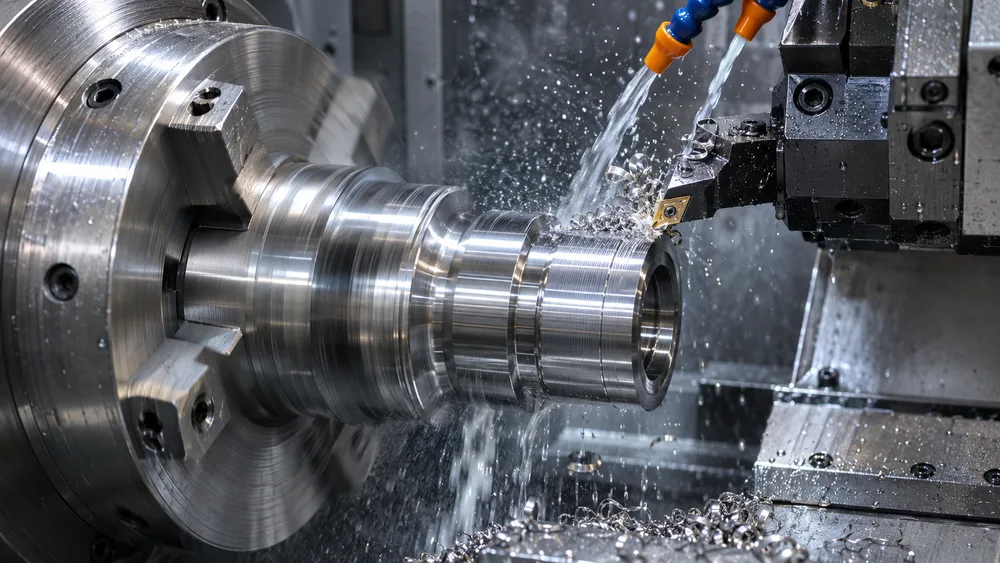
Choose CNC turning when most of your part can be defined around a centerline. Shafts, bushings, pins, sleeves, threaded components and similar parts are natural candidates because the workpiece rotates while a cutting tool forms diameters, faces, bores and grooves.
That geometry matters more than the part’s industry label. A well-matched turning process can reduce setups, maintain alignment between concentric features and remove material efficiently. A poor match—such as a heavily prismatic part with large pockets or multiple off-axis features—can add secondary operations and unnecessary cost.
CNC turning holds stock in a chuck or collet and rotates it against a controlled cutting tool. Because the primary surfaces are generated around the same spindle axis, the process is particularly useful when outside diameters, inside diameters and shoulders must remain concentric.
Buyers sometimes select a supplier by asking for “tight tolerance CNC turning” without identifying which dimensions are actually critical. That can lead to conservative process planning, longer inspection time and a higher quote. Mark the functional interfaces instead: a bearing seat, sealing diameter, press-fit bore, thread or face that establishes assembly position.
Turning is often efficient for round bar stock, but it isn’t automatically the lowest-cost route for every cylindrical-looking component. Large material-removal ratios, thin walls, interrupted cuts and stock that is difficult to grip can change the production plan.
A CNC lathe can create several related features while the component remains in one controlled setup. Common candidates include:
Long, slender parts deserve extra review. Cutting forces can deflect the workpiece, while deep bores can restrict tool access and chip evacuation. Thin walls may also move during machining or after clamping pressure is released. These are process-planning issues, not details to leave until production begins.
Flat faces, cross-holes, keyways, radial slots and off-center patterns may require milling after the turning work. If those features dominate the drawing, starting on a machining center can make more sense. If the part remains mostly rotational, a combined turning-and-milling route may reduce transfers and the alignment errors that can come with re-fixturing.
DS Industrial lists Nakamura machines and Citizen M32 and L20S machines among its CNC equipment, alongside Makino machining centers. Machine selection still depends on the drawing, material, stock form, feature access and order quantity; a machine name alone does not establish process capability for a specific part.
The main production advantage comes from controlled tool motion relative to the spindle axis. Once the process, tooling and workholding are established, the same programmed path can be repeated across a batch. Keeping related diameters and faces in one setup can also limit datum-transfer errors.
Repeatability does not mean every tolerance is easy or that every dimension will hold the same process capability. Tool wear, material variation, heat, workpiece deflection, chucking pressure and chip control all affect results. Surface finish can also deteriorate if a tool chatters, rubs instead of cuts, or recuts trapped chips.
Efficient material removal is most likely when the starting stock is reasonably close to the final diameter and can be held securely. Oversized stock creates more chips and cycle time. Near-net stock may save cutting, but it can bring its own availability, straightness or minimum-order constraints. A practical quote considers both machining time and material sourcing rather than treating either in isolation.
DS Industrial (Shenzhen) Co., Ltd. provides CNC turning and milling for samples, flexible small batches and customized mass production. This range is useful when you need early parts for assembly checks, followed by repeat orders after the design is released.
A prototype and a production batch may use different assumptions. Prototype work can prioritize speed and design verification, while production planning may justify dedicated workholding, revised stock selection or more formalized inspection frequency. Be clear about the expected annual or release quantity so the quote reflects the actual sourcing plan.
You can review examples of custom CNC machining work before sending a drawing. DS Industrial states that quotes are generally delivered within 24 hours, although timing can depend on drawing completeness and the need to clarify materials, tolerances or finishes.
DS Industrial states that it is ISO 9001:2015 certified. Certification indicates that a documented quality management system is in place; it should not be mistaken for proof that an unspecified tolerance or inspection plan applies automatically to every order.
Depending on project requirements, the company offers dimensional and visual inspection reports, First Article Inspection, material certificates or test reports, and CMM inspection. Request the records you actually need in the RFQ. Adding them after parts are finished can create delays, especially if traceability or a specific reporting format was not planned at order entry.
A usable CNC turning quote needs more than a model file. Submit a controlled drawing and confirm:
Machine envelope and tool access must be checked against the complete geometry. The largest outside diameter is only one constraint; overall length, bore depth, workholding allowance and access to back-side features can determine whether a second setup or different machine is needed. For context, see DS Industrial’s precision turned and machined parts gallery.
Send your 2D drawing, 3D model, material requirement, quantity and required delivery location for review. Identify the dimensions that affect fit or function rather than applying restrictive tolerances to the entire part. That gives the manufacturing team a clearer basis for selecting CNC turning, milling or a combined route.
For low-volume United States orders, DS Industrial states that international fulfillment can include FedEx shipping. Packaging, shipping method, lead time and import responsibilities should still be confirmed for your order. Start with a drawing-based CNC turning quote and request an inspection and delivery plan suited to your project.
Most of our quotes are delivered within 24/36 hrs. and usually in much less time, depending on project details.
Our team will contact you directly about your CNC machining quote to ensure you’ve received and understand all aspects of your quotation and to answer any questions you may have about your options.