
DS provides drawing-based custom CNC milling for samples, flexible small batches, and customized production orders. The process starts with a review of your CAD files, drawings, quantities, material requirements, critical dimensions, and inspection needs. CNC machining projects are quoted within 24 hours after the required information is available.
The practical goal is simple: identify manufacturability issues before material is cut, then align production and inspection with the requirements on your drawing. That matters more than vague claims about “precision.” A useful milling supplier should tell you which features are difficult to reach, where workholding may leave witness marks, and which tolerances need explicit verification.
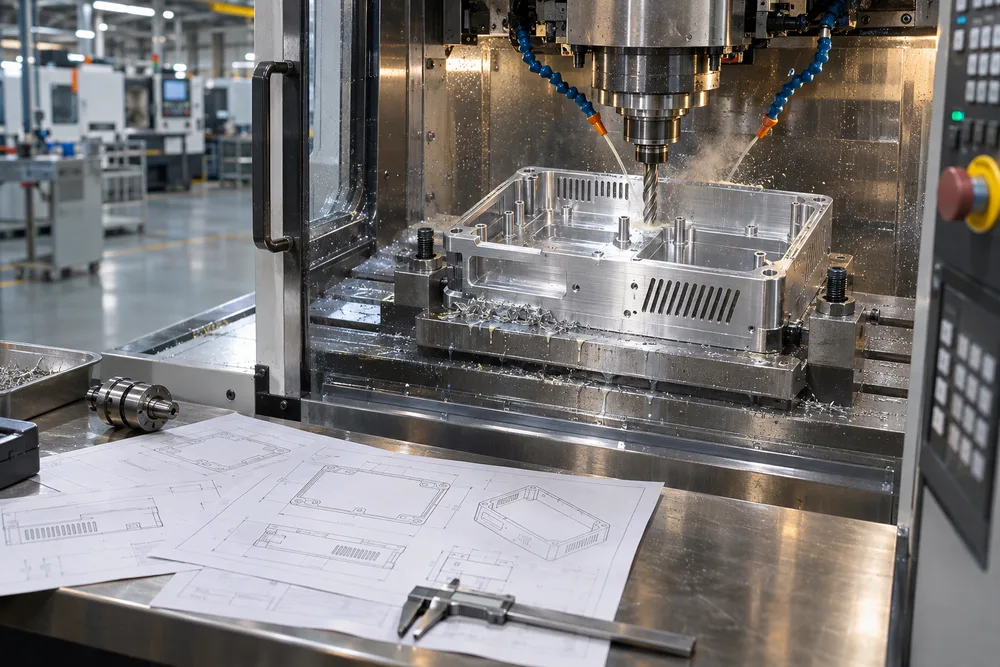
CNC milling removes material with rotating cutting tools while the workpiece is held in a fixture. It is commonly chosen for parts with pockets, mounting faces, hole patterns, channels, bosses, and other features that need controlled relationships to defined datums.
DS supports prototype CNC milling and low-volume CNC milling without limiting the service to one project stage. You can begin with samples for fit or functional review, revise the design if needed, and then place a customized production order. If a part also requires turned features, sheet metal components, cast components, or assembly, DS offers those services as separate or complementary processes.
Before sending an RFQ, review examples of CNC-machined parts to see the types of components and feature combinations associated with DS production work.
CNC milling is a practical fit when geometry must be generated from multiple faces or when flatness, hole position, pocket depth, or relationships between features matter. DS product vocabulary includes unibody enclosures, manifolds and valves, sensor housings and enclosures, and link arms.
Don’t choose milling only because the CAD model can be machined. Deep narrow pockets, inaccessible internal corners, thin walls, and excessive setups can raise cost or increase distortion risk. Annual demand, geometry stability, material, finish, and inspection burden all affect whether outsourced CNC milling remains the right production method.
| Project requirement | DS capability or review point |
|---|---|
| Machining equipment | DS lists Makino machining centers for CNC work. |
| Order stage | Samples, flexible small batches, and customized production orders. |
| Complementary processes | CNC turning, die casting, investment casting, sheet metal fabrication, and assembly. |
| Inspection evidence | Visual inspection, dimensional inspection, CMM inspection, and First Article Inspection documentation. |
| Material records | Material certificates or test reports are available on request. |
| U.S. shipping | FedEx is identified as an available shipping option. |
A milling review should follow the cutting tool and fixture, not just the nominal model. DS reviews geometry and access requirements before production. Features hidden behind walls may require another setup or a different machining approach. Internal corners retain a radius because milling cutters are round; specifying sharp internal corners without a functional reason adds avoidable difficulty.
Workholding deserves the same attention. A part needs enough stable material to clamp without damaging functional surfaces or allowing movement under cutting forces. Thin sections can deflect during machining, while cosmetic faces may need agreed clamp locations and handling controls. Multi-axis machining may reduce setups for some geometries, but suitability must be confirmed from the actual files rather than assumed from a search for a 5-axis CNC milling service.
Send the project package to DS for review. The team checks the supplied geometry, requirements, order quantity, and requested documentation, then prepares a CNC milling quote. CNC machining projects are quoted within 24 hours once the information needed for review is available.
After commercial and technical details are agreed, the order moves through material preparation, machining, any specified finishing, inspection, packing, and shipment. Sample approval or a documented first-article stage should be identified before production begins—not after the full batch has been made.
Provide a 3D CAD file and a controlled 2D drawing where possible. The drawing should identify datums, tolerances, threads, surface-finish requirements, cosmetic zones, material grade, finish, and any standards that govern acceptance. Include sample and production quantities so DS can review setup effort against the expected batch.
Call out the dimensions that affect assembly or function. A blanket tight tolerance on every feature usually increases inspection and machining effort without improving the part. Also state whether you need CMM results, First Article Inspection documentation, material certificates, or test reports in the RFQ; these records shouldn’t be treated as an assumption.
Lead time depends on material availability, geometry, setup count, quantity, finish, inspection scope, and whether requirements are complete at quotation. Drawing revisions, uncommon stock, extensive CMM reporting, or an outside finishing step can change the schedule. DS lists separate sample and production lead-time ranges on its website, but your confirmed quotation and order documents should govern the actual project.
Packing should reflect part mass, finish, corrosion sensitivity, and the surfaces that cannot contact one another. For U.S. customers, FedEx is available as a shipping option. Freight method, packaging, delivery address, and any import responsibilities should be settled before dispatch.
DS states that it is ISO 9001:2015 certified. Certification supports a documented quality management system, but it doesn’t replace a clear drawing or project-specific acceptance plan. Your purchase requirements still need to define what will be measured, how results will be reported, and which records must ship with the order.
Available inspection evidence includes visual and dimensional inspection, CMM inspection, and First Article Inspection documentation. Material certificates or test reports can be requested. The right package depends on risk: a cosmetic cover, a manifold with critical ports, and a housing with datum-controlled bores don’t need identical reporting.
For a closer look at relevant component types, see DS’s custom CNC milling project gallery.
Send your drawing package, quantities, material and finish requirements, critical features, and inspection-document needs for review. You can also use the DS CNC machining gallery to identify comparable part types before requesting your quote.
Most of our quotes are delivered within 24/36 hrs. and usually in much less time, depending on project details.
Our team will contact you directly about your CNC machining quote to ensure you’ve received and understand all aspects of your quotation and to answer any questions you may have about your options.