
Price gets attention first. It should not make the final decision. A China CNC machining supplier is a good fit only if it can make your geometry by the right process, inspect the features that matter, communicate clearly before chips are cut, and ship parts to the United States without leaving critical details to assumption.
The Short Answer: Choose for Process Fit, Evidence, and Reliable Execution
Choose the supplier that gives you the clearest evidence of process fit, quality control, and execution—not simply the lowest unit price. A low quote can hide omitted inspection, an unsuitable machining setup, unclear material sourcing, or a lead time that begins only after unanswered drawing questions are resolved.
Start with your part, not a supplier brochure. Identify its material, geometry, critical dimensions, cosmetic requirements, order volume, and required records. Then ask each supplier how it plans to manufacture and verify those requirements. The useful answer is specific: milling versus turning, how a feature will be accessed, what will be inspected, and which documents can be supplied.
DS Industries (Shenzhen) Co., Ltd. offers CNC machining services alongside casting, sheet metal fabrication, tooling, and pattern making. That broader process range can be useful if you need to compare manufacturing routes rather than force every part into a CNC-only quote.
Confirm That the Supplier Can Make Your Part the Right Way
Ask for a manufacturing review before you place an order. The supplier should be able to identify inaccessible internal corners, thin sections that may move during machining, tolerance callouts that need a datum scheme, and features that require a second setup. Silence at this stage is not efficiency; it is often a problem deferred to production.
Match Your Part to CNC Milling, CNC Turning, or Gear Hobbing
CNC milling suits prismatic parts: plates, housings, brackets, manifolds, and parts with pockets, slots, drilled holes, or angled faces. Three-axis milling is often sufficient where all features can be reached from practical orientations. Five-axis CNC milling becomes relevant when compound angles or multiple faces must be machined with fewer repositioning steps. It can reduce setup-related variation, but it is not automatically the best or least expensive answer for every part.
CNC turning is the natural route for shafts, bushings, pins, rings, and other parts built around a central axis. If a turned part also has flats, cross-holes, or milled features, ask how those secondary operations will be held and referenced. For toothed components, gear hobbing may be the appropriate process. Do not call a gear “machined” and assume the tooth form, inspection method, and mating requirement have been understood.
DS lists 3- and 5-axis milling, CNC turning, and gear hobbing among its capabilities. For custom CNC machined parts, send the actual model and drawing so the proposed route can be checked against your geometry rather than guessed from a product category.
Decide When CNC Machining Is a Better Fit Than Casting or Sheet Metal Fabrication
CNC machining is usually the direct choice for tight features, prototypes, lower quantities, or parts cut from solid stock where dimensional control matters more than near-net-shape material savings. It is also practical for design revisions because a CAD change may require a program update rather than a new production tool.
That said, machining every surface from a billet can be wasteful for a large, complex part that is well suited to investment casting or die casting. Sheet metal fabrication is often the more sensible route for bent enclosures, brackets, and formed panels. The missed opportunity is not choosing the “wrong country.” It is choosing the wrong process because the buyer did not ask for alternatives. Request a comparison if your part has deep cavities, substantial material removal, cast-like geometry, or repeated formed bends.
Start With a Complete Drawing and CAD File Package
A quote is only as reliable as the package behind it. Send a dimensioned drawing with revision control, material callout, finish requirements, tolerances, thread specifications, and any critical-to-function features. A 3D model describes shape; it does not always define inspection intent, surface requirements, or which dimension controls an assembly.
Include the native or neutral CAD file your supplier can open. DS accepts STEP, STP, SLDPRT, DXF, STL, IPT, 3DXML, PRT, and SAT files for quotation. Mark areas that must remain free of clamp marks, features that need special protection in transit, and any mating surfaces whose requirements are not obvious from the model.
Before approving production, resolve conflicts between the 2D drawing and 3D file. State which document governs if a discrepancy appears. This is a small administrative step that prevents expensive rework and arguments over what the supplier was meant to build.
Verify Inspection Methods and Quality Documentation Before Ordering
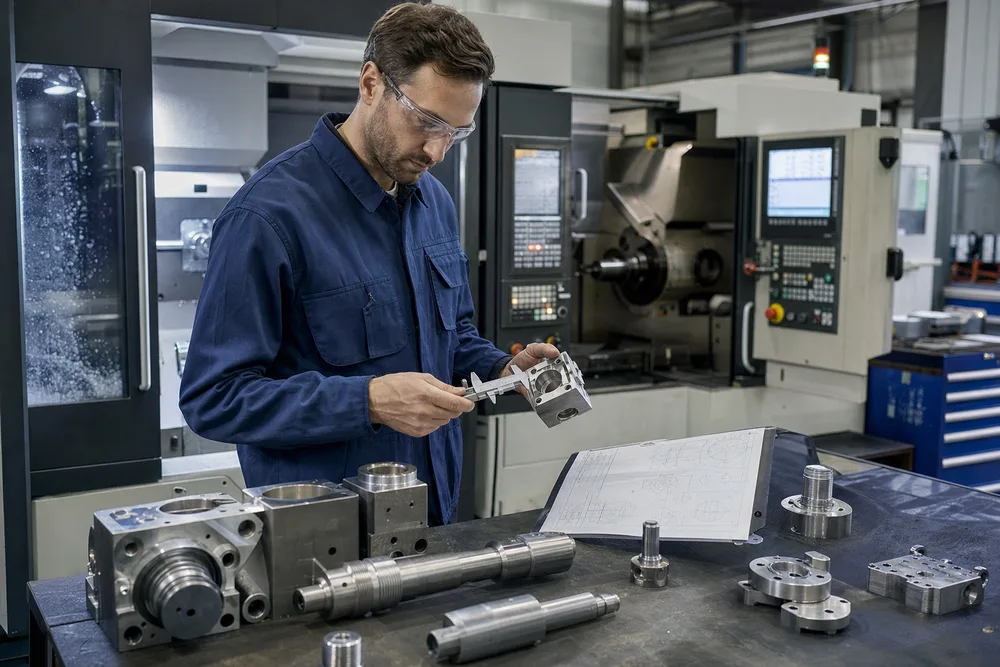
Inspection claims matter only when tied to your part. Ask which dimensions will be checked, what equipment is appropriate for those features, and whether results will be recorded. A caliper can confirm many external dimensions; it cannot substitute for a coordinate measuring machine on a feature pattern or complex spatial relationship.
DS cites ISO 9001:2015 certification, twice-performed part inspection, and CMM inspection. Those are useful indicators, but you should still define the inspection scope in the purchase order. ISO certification does not automatically mean every dimension is measured or every lot receives the same report.
Ask What Inspection Records, Material Certificates, and Test Reports Are Available
Ask for the documents your program actually needs before the quote is finalized. DS states that first article inspection, material certificates, and test reports are available as options. Confirm whether each is included, what part revision it covers, and whether it will be supplied with the shipment or approved before full production begins.
A first article is particularly useful where dimensions affect a mating component, a medical or industrial assembly requires traceability, or a new supplier is making the part for the first time. For repeat orders, agree on what triggers renewed first-article review: a drawing revision, material change, tooling change, or process change. Buyers often discover this requirement only after receiving parts that are technically usable but unsupported by the records their customer requires.
Check Communication, Lead-Time Variables, and Shipping to the United States
Evaluate communication during quotation because it predicts production control. Are questions consolidated and specific? Does the supplier restate the material, revision, quantity, finish, and inspection requirements? Can it explain what is included in the lead time and what starts the clock—purchase order, drawing approval, material arrival, or first-article approval?
China CNC machining lead time is affected by material availability, programming, setup count, outside finishing, inspection documentation, order quantity, and shipping method. Do not compare two delivery promises unless both quotes define the same finish, documentation, packaging, and shipping terms. A shorter production lead time is not helpful if export packing, freight booking, customs paperwork, or final inspection sits outside the stated schedule.
For US shipments, clarify the shipping method, Incoterms, party responsible for duties and customs clearance, package labeling, and who receives tracking and shipping documents. If parts are scratch-sensitive or have precision threads, specify protection rather than assuming standard packaging is enough.
Questions to Resolve Before You Request a China CNC Machining Quote
Use this list to compare China CNC machining manufacturers on the same basis:
- Can the supplier name the proposed milling, turning, gear hobbing, casting, or sheet metal process and explain why it fits?
- Have you sent the current drawing revision, CAD model, material, finish, tolerance requirements, and target quantity?
- Which dimensions or features will receive CMM inspection or other recorded checks?
- Are first article inspection, material certificates, and test reports required, optional, or excluded?
- What assumptions are built into the quote for finishing, packaging, lead time, and shipping to the United States?
- Who approves questions, revisions, and any substitution before production proceeds?
Send that package with your RFQ, then compare answers line by line. If you need a supplier review across machining and related metal processes, contact DS Industries with your drawing and CAD files for a quote discussion.